

Perception of parasports, part 1
Since I started out in wheelchair athletics, I have seen how parasports have developed and how the perception and acceptance of them within society have changed. As a professional wheelchair athlete, I would like to take a closer look at a number of specific points and share my views.
Sporting achievements as cultural achievements
A sporting achievement is a cultural achievement. It is an expression of our human potential. Watching someone run the fastest 100-metre time ever or seeing a high jumper with only one leg beat the high-jumping record in their category are equally impressive to me. They are expressions of precisely this potential.
However, achievements are difficult to assess and can only be compared with one another to a limited extent. This is particularly true of parasports, where many viewers have no direct experience of the specific disciplines and equipment. Most of us have jumped, kicked/thrown a ball around or skied at some point in our lives, so we have some idea of what achievements in these areas involve. However, very few of us have ever sat in a racing wheelchair or used a handcycle. Sporting achievements in these disciplines are harder for us to grasp.
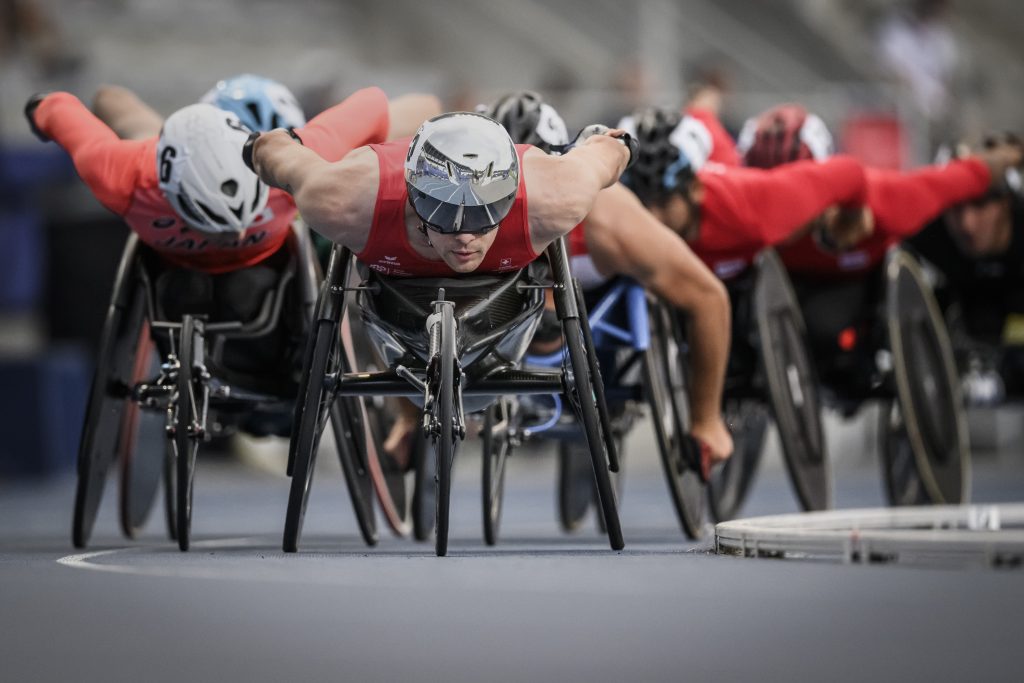
Superhuman or athlete?
For some people, simply “overcoming their fate” is a feat in and of itself, and sporting achievements are viewed as additional, special accomplishments – a triumph against all the odds, as it were. As a result, sporting achievements by para-athletes are often ranked higher and described as being “worth more”, while simultaneously not receiving any additional recognition. Since the 2012 Paralympics in London, the term “superhuman” has often been used – especially in a campaign by one particular TV channel – to glorify the achievements of athletes with disabilities. The narrative of the “supercrip” is a common one. Yet achievements by people with disabilities, be they sporting or in any other walk of life, should be assessed realistically and measured by the same yardstick as achievements by non-disabled people. They aren’t worth more, and they aren’t worth less. Achievements should not be overrated, and underperformance should not be sugar-coated. Everyone does their best and attempts to perform to their maximum ability. At that moment, the person’s disability and background are irrelevant. In the same way that origins, religion, status, etc., should play hardly any role at all in elite sports, I believe that disability should be secondary in parasports (except for the purpose of assigning athletes to a category based on their impairment). When I’m at the starting line of a race, the reasons why my competitor is in a wheelchair are of little interest to me. It’s simply a case of “May the best one win.” Since they are important facts in athletes’ biographies, it is understandable that the disability and the reasons for it are mentioned in news coverage. But the link between the disability and the sport should not be overemphasised. Unfortunately, many people don’t see it that way. If para-athletes have a moving life story and achieve superhuman feats, they can be “sold” more effectively in the media and in marketing campaigns than via their sport alone. Another danger of glorifying para-athletes, in my opinion, is that this attitude can be carried over to other people with disabilities, raising expectations that they too must “achieve something special”.
The health aspect
In my experience, there is a common conception that people with disabilities engage in sport primarily for health reasons. This interpretation is understandable given the strong links between disabilities and physical health. And it is indeed true for the majority, especially in recreational sports, just as it is among people without disabilities. The health aspect is doubtlessly very important, but in elite sports it is not the priority, and that also goes for parasports. This is not to say that elite sports should go beyond the boundaries of what is healthy. In an ideal scenario, they should promote physical and mental health.
I already tried to encapsulate this thought in a quote that I gave as an adolescent athlete:
“I do sport although I’m in a wheelchair and not because I’m in a wheelchair.”
Lack of broad popularity
Parasports are fringe sports and are always likely to remain so. They are not very popular. Whereas non-disabled sports are practised by thousands or even millions of people, only a fraction of that number participate in parasports. There is also a small dilemma facing parasports: on the one hand, the goal is to increase popularity and participant numbers, whereas on the other, it is of course desirable for there to be as few people as possible in the world with disabilities. At the end of the day, the only option is to appeal to the small target group of people with disabilities and potential future para-athletes as efficiently as possible and get them interested in parasports. An additional factor is that the range of different sports has increased significantly, with even the most unlikely of games being being adapted for parasports. Whereas just a few years ago, para-athletes were spread across a small number of well-known sports, now the range of options is much bigger. As a result, some sports are basically competing against one another. Sport must be promoted and participation facilitated at all levels, but at Paralympic level, in my opinion, it should be possible to make the fulfilment of certain requirements mandatory.
Parasports and elite sports – a contradiction?
Within the different sports and disability categories, there are sometimes big differences between performance levels, including in proportion to participant numbers. In some parasports, the performance level is very high – comparable to that of non-disabled sports. A lower number of participants in a sport does not necessarily mean that the performance level will be lower.
As a result, perhaps not all but some Paralympic disciplines can certainly be regarded as elite-level, high-performance sports. The amount of effort that the athletes invest in order to become the best in the world is comparable with Olympic sports.