

Perception of parasports, part 2
Categories galore and the quest for fairness
The large number of categories can be described as a necessary evil of parasports. The purpose of the category classifications is to take into account the different types and degrees of disability and guarantee a reasonable level of fairness and equal opportunities. Paradoxically, all the different categories make parasports a “master of differentiation and exclusion”. The more categories there are, the more boundaries are drawn and the more grey areas created. This regularly leads to discontent and heated discussions – usually about athletes allegedly being assigned to the wrong categories and a lack of equal opportunities. Since I am in the category with the lowest impairment level in my sport, such discussions are fortunately rare for me.
The many different categories lead to both a fragmentation of the athlete fields in the individual categories – which are often small already – and to a confusing situation for spectators. In my opinion, a sensible solution for sports with individual starts has been found in alpine skiing. On the basis of a carefully calculated factor, the clock is set to run at different speeds depending on the athlete’s degree of impairment. The athlete who reaches the finish line in the “fastest” time then wins. This method is applied across categories and is reasonably easy for spectators to understand.
While some people call for more categories in order to better cater to the individual impairments, others want to see categories merged – in favour of larger fields, greater attractiveness, a reduction in the deluge of medals and increased simplicity. This discussion can go so far that one ends up wondering why we don’t simply open up some sports to everyone, including participants without disabilities? Allow me to ask a provocative question: would that not be true inclusion? In some sports, such a solution would be almost impossible to implement – at least not without putting the para-athletes at a considerable disadvantage. In my category of wheelchair athletics, however, I could theoretically envisage such a scenario. Competitors without disabilities might have an advantage thanks to their core strength. Yet at the same time, they could be at a disadvantage due to their weight (more muscle mass in the legs) and because the sensation and circulation in their legs might force them to adopt a different sitting position. Of course this remains hypothetical, but it is an imaginative and progressive idea that is certainly worthy of consideration. The converse practice of having para-athletes participating in sporting competitions for non-disabled athletes is already practised in a small number of cases, albeit subject to certain requirements and restrictions. German long jumper Markus Rehm has competed against athletes without prosthetic limbs on a number of occasions, for example.
For anyone who wants to know more about the complex topic of the different parasports categories, I recommend the following blog article by the Swiss Paraplegic Group Community.
Not a social event
Just like in non-disabled sports, an elite parasports competition is definitely not a social event. The best one wins, period. No one makes any concessions and it is about far more than just taking part. Unfortunately, many outsiders still take a different view, attaching particular importance to the social idea in parasports. I’m exaggerating slightly, but essentially they feel that everyone should leave the track/pitch/court, etc., a winner. My position on this issue is clear: absolute equality and justice do not exist in elite sports, only fairness. One simple reason why there can be no equality is that our physical make-ups naturally differ from person to person. A person who is 1.60 metres (5 foot 3 inches) tall would probably think twice before opting for basketball as their elite sport of choice, and they could hardly demand that a separate high-jumping category be created for people of their height. Everyone must try to achieve the best they can with the personal attributes and abilities they have, and it is up to them to decide whether to enter a competition or not.
Average age and ambitions
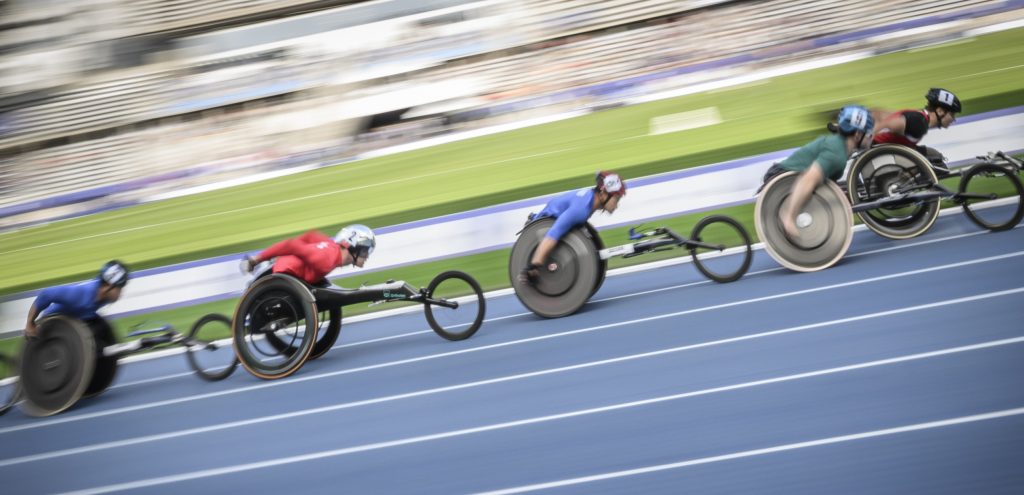
I have noticed that in some elite-level parasports and certain individual categories, the average ages are significantly higher than in their non-disabled equivalents. Why that is the case is something I can only speculate about. Of course it is legitimate to decide for ourselves how long we want to remain active as elite athletes and we can be glad of every athlete who increases participant numbers. The first time I spoke publicly about my thoughts of retiring, many well-meaning people told me that I could definitely follow others’ examples and continue my career as a successful athlete until at least the age of 60. Although the fact that people didn’t want me to retire was flattering, these words of encouragement also showed that parasports still aren’t taken as seriously as they should be. I am confident, however, that average ages will continue to fall in parasports and begin to converge with those in non-disabled sports over the next few years, as performance levels and participant numbers increase. One interesting development has been noticeable for some time: whereas in the past, it was possible and even common to begin a parasports career at an advanced age – for instance after an accident at the age of 20 – and go on to reach the top ranks globally, this is practically impossible in many sports today. Many disciplines, including wheelchair athletics, are dominated by athletes who have been in wheelchairs since childhood. Logically, these athletes will often have an advantage from the outset. On the one hand, they have been accustomed to moving around in a wheelchair since their childhood and have therefore already developed the required arm and shoulder muscles, joint strength and motor skills, and on the other, they can start training and competing in their sport much earlier.
Despite this, I still see a small number of athletes of moderately advanced to advanced age who have only just started out in parasports and seem to view taking part in the Paralympics and even winning a medal as a matter of course. The obstacles involved and the long, tough path that athletes have to follow to reach this level are often underestimated.
In our society, we attach great importance to ensuring that everyone exercises as much as possible. This is equally true for people with disabilities. A large population of recreational athletes is followed by a smaller group of performance-oriented athletes and an even smaller group of elite-level athletes.
A promising future
In spite of these weaknesses and the catching-up that a self-critical perspective shows is needed, the fact is that parasports have evolved in a very positive way and will continue to do so in the future. Their reputation and the level of interest they attract have changed and they have become more visible. There have also been big advances in terms of inclusion in many areas. The athletes and the people around them work more professionally and meticulously, and they often receive more support, be it from associations, organisations or other partners. Further parameters such as good infrastructure (as we have here in Nottwil) have been put in place and the athletes are looked after by expert coaches. I hope and wish that this will also be possible for future generations.
It is encouraging that achievements in certain para-sports are attracting greater rewards in the form of increasing prize money. As in my case with marathons, in some disciplines the rewards are even slowly converging with those of runners. This enables more and more professional and semi-professional athletes to make a living from sport and continue to raise their level. A lot is happening in a technical sense too and renowned companies are championing new innovations. Yet there is still a great deal of potential and much to be done at various levels. Para-sports could be made easier to understand and follow, for example. This can be achieved, not least, through more intensive public relations work in collaboration with media partners and via good commentators at the competition venues. Parasports are currently going through an exciting period of change and it is essential that we stick at it!
Looking ahead, I believe that I can see a positive and extremely exciting future for the younger parasports generations. The young athletes know how to use digital media and take advantage of their enormous potential. Ever greater audiences can be reached and strong, relevant messages disseminated. The different sports are becoming even more professional and attractive and media interest is growing. Young para-athletes are demonstrating a whole new self-image. They are full of confidence and know what they are worth – not least thanks to the new attitude to the inclusion of people with disabilities and the progressive perception of parasports within society.